
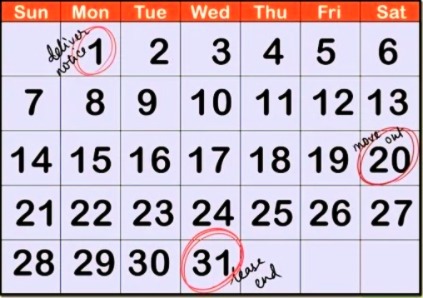
Issue: What is the difference between a “month” and a “calendar month?”
Here’s a question from Rumbi:
I am a student renting private accommodation in an apartment. I had a 12-month lease, but I would like to leave early. I have no real problem with the property; it’s just that I want somewhere closer to campus. It’s not a problem in the morning or during the day as there is plenty of public transport. However, it becomes tricky when I leave the library late at night. There are no buses or taxis, and even Ubers are scarce, with those available being expensive.
Anyway, I gave my landlady notice to vacate on the 3rd of March and told her I would be leaving on the 3rd of April. She says that I must give a calendar month’s notice, meaning my notice runs from the 1st of April until the end of April. I don’t understand why she is saying this. I gave her an entire month’s notice. What is the issue? She seems to be just looking for ways to withhold my deposit. I need my deposit back because I need to use it as a deposit for the room I want to move into.
From The Legal Desk:
Thanks for your question, Rumbi. The issue of rental deposits should be straightforward, but it often causes unnecessary stress in rental agreements. In most cases, simple language can make things abundantly clear. Nonetheless, to clarify your situation, let’s take a look at the legals…
When it comes to contracts like lease agreements or employment contracts, the term “calendar month” often arises alongside the more usual term “month.” The distinction between these terms can sometimes be confusing, as many employers or landlords do not explain this distinction upfront.
In the case of South African Music Rights Organisation Ltd (SAMRO) v Mphatsoe,1 the court faced a situation not too dissimilar to yours, albeit in the realm of employment. Similarly to you, the respondent had given their month’s notice on the 8th of January 2008 and ceased working on the 8th of February 2008. Their employer, SAMRO, argued that the employee ceased work prematurely as they were required to work until the 29th of February 2008. SAMRO contended this was because a calendar month’s notice was effective from the 1st of the following month to the end of that month.
In SAMRO, Van Niekerk J emphasised that understanding the term “month’s notice” requires considering the entire employment contract rather than interpreting it as an isolated one. The learned judge noted that, while the termination clause specified “calendar” preceding the notice period, other sections of the contract used “monthly” or “month” without the “calendar” qualifier. For instance, payment terms were stated as “monthly,” indicating regular intervals without specific alignment to a calendar month.
The court concluded that including “calendar” in the termination clause suggested a distinct interpretation, implying notice would only be effective from the beginning to the end of the same month. Thus, within the broader context of the contract, “calendar month” implied a different meaning than simply “month.”
I have looked at the copy of your lease agreement which you sent me, and I can see that, similar to SAMRO, your lease agreement stipulates that a calendar month’s notice must be submitted before vacating the premises. Section 3.4 of your lease agreement reads as follows:
“Should the Tenant wish to vacate the Premises prior to the expiration of this lease agreement, the Tenant will be required to give a full calendar month’s notice as notice to vacate. Failure to do this will result in the Tenant forfeiting there deposit.”
I should note that the court in SAMRO did caution against blanket interpretations of the term “calendar month”. In other words, “calendar month” could mean one thing in one case and then mean something else in another case. What is important is the context in which the term is used. In your case, I agree with your landlady; by giving her notice on the 3rd of March, your calendar month started on the 1st of April and ran until the 30th of April. This is based on the fact that your lease agreement explicitly mentions “calendar month” when discussing notice to vacate, while elsewhere in the agreement, the terms “month” or “monthly” are used.
Notices generally exist to allow the landlady to find other tenants to replace the incumbent without suffering any financial shortfalls due to the tenant’s unexpected departure. As such, most landlords are amenable to you finding someone to replace you should you opt to vacate prematurely. Note, though, that they are not obligated to accept this option.
Written by Theo Tembo
citation: Tembo, T. “What is the difference between a “month” and a “calendar month?” (19 Jun 2024). The Legal Desk. Available at: https://wp.me/pfvcwT-3r.
Read more from The Legal Desk:
- Baker Fired Over 11,000 Loaves of Bread Wins Reinstatement
- Justice at Last? SCA Acquits Man in Botched Trial
- (2009) 30 ILJ 2482 (LC). ↩︎






 The Legal Desk
Leave a comment