
Understanding the DNA Testing Process in Criminal Investigations
A distressing case has featured in the news recently concerning a 7‐year‐old minor who was allegedly assaulted at school. The incident is reported to have occurred in October or November 2024. At the time of writing, it remains unclear precisely what transpired or the current stage of the police investigation. However, it has emerged that, unlike two other suspects, the principal of the school has refused to submit to a DNA test in order to be excluded as a suspect. As might be expected, this refusal has intensified public indignation, with many contending that, were he innocent, he would have no objection to providing a DNA sample to the police.
But what precisely constitutes a DNA test in such circumstances, and why have the police not simply compelled the principal to undergo this procedure? This article is not intended to examine the tragic alleged assault on the young girl, but rather to shed light on the legal process that governs the collection of DNA samples from suspects by police officials.
The Criminal Law (Forensic Procedures) Amendment Act1 (colloquially known as the DNA Act) amended the Criminal Procedure Act (CPA)2 to mandate the collection of specific bodily samples for forensic DNA analysis from certain individuals. The aim was to ensure, inter alia, the protection of women’s and children’s rights, to regulate evidence through affidavit or certificate, and to add Schedule 8 to the CPA, which lists the offences that require DNA samples.
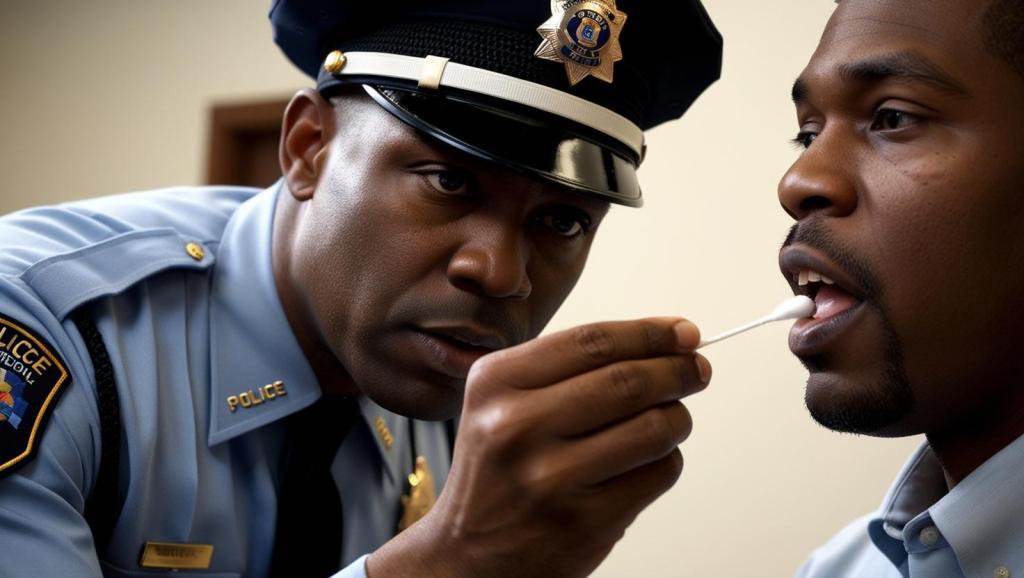
When analysing this legislation, several key terms warrant attention. What the general public typically refers to as a “DNA test” is professionally known as a buccal sample. A buccal sample is a collection of cellular material taken from the inside of a person’s mouth.3 Likewise, the term “bodily sample” refers to intimate or buccal samples collected from an individual.4 It is precisely this buccal sample that the principal in question has refused to provide.
Section 36D(1) of the CPA reads as follows:
Subject to section 36A(5),5 an authorised person must— (a) take a buccal sample; or(b) cause the taking of any other bodily sample by a registered medical practitioner or registered nurse defined in the National Health Act, of any person—(i) after arrest but before appearance in court to be formally charged for any offence referred to in Schedule 8; (ii) released on bail in respect of any offence referred to in Schedule 8, if a buccal sample or a bodily sample of that person was not taken upon his or her arrest; (iii) upon whom a summons has been served in respect of any offence referred to in Schedule 8; (iv) whose name appears on the National Register for Sex Offenders; or (v) charged or convicted by a court in respect of any offence, which the Minister has by notice in the Gazette, and after notification of Parliament, declared to be an offence for the purposes of this subsection.
Section 36D(2) of the CPA reads as follows:
(2) Subject to section 36A(5), an authorised person may—(a) take a buccal sample; or (b) cause the taking of any other bodily sample by a registered medical practitioner or registered nurse, of any person—(i) after arrest but before appearance in court to be formally charged in respect of any offence; (ii) released on bail in respect of any offence, if a buccal sample or bodily sample was not taken upon his or her arrest; (iii) upon whom a summons has been served in respect of any offence; (iv) whose name appears on the National Register for Sex Offenders; or (v) charged or convicted by a court in respect of any offence, which the Minister has by notice in the Gazette, and after notification of Parliament, declared to be an offence for the purposes of this subsection.
The key differences between sections 36D(1) and 36D(2) of the CPA lie in the obligation imposed on an authorised person and the scope of offences covered at the point of arrest prior to a court appearance. Section 36D(1) imposes a mandatory obligation on the authorised person to take a buccal sample or to cause the taking of another bodily sample under the specified circumstances. It specifically applies to individuals arrested for any offence referred to in Schedule 8, which include rape and sexual assault.
Conversely, section 36D(2) confers a discretion on the authorised person regarding the taking of a buccal sample or another bodily sample and applies to individuals arrested for any offence, without the specific limitation to Schedule 8 offences. Consequently, it possesses a broader application across various categories of crimes.
Both sections share some common requirements that buccal samples must or may be taken from individuals who:
- have been arrested but have not yet appeared at their first court appearance;
- have been released on bail if a sample was not taken upon arrest;
- have been served with a summons;
- have names listed on the National Register for Sex Offenders; or
- have been charged or convicted of an offence specifically declared by the Minister in the Gazette for this purpose.
There are, however, occasions when individuals do not fall within any of the above categories, yet a buccal sample is required for investigative purposes. This is the category into which the principal in question would fall, and such instances are regulated by section 36E of the Criminal Procedure Act. Section 36E reads as follows:
36E(1) Subject to subsection (2) and section 36A(5), an authorised person may take a buccal sample of a person or a group of persons, or supervise the taking of a buccal sample from a person who is required to submit such sample and who requests to do so him- or herself if there are reasonable grounds to—(a) suspect that the person or that one or more of the persons in that group has committed an offence referred to in Schedule 8; and (b) believe that the buccal sample or the results of the forensic DNA analysis thereof will be of value in the investigation by excluding or including one or more of those persons as possible perpetrators of the offence. (2) If a person does not consent to the taking of a buccal sample under this section, a warrant may be issued by a judge or a magistrate if it appears from written information given by the authorised person on oath or affirmation that there are reasonable grounds for believing that—(a) any person from whom a buccal sample is required has committed an offence listed in Schedule 8; and (b) the sample or the results of an examination thereof will be of value in the investigation by excluding or including that person as a possible perpetrator of the offence.
As can be gleaned from section 36E, an individual who is merely under investigation must consent to the taking of a buccal sample. As highlighted in section 15K(2) of the SAPS Act, “informed consent” means that the person consents, in writing, to the taking of a buccal sample after a police official has informed him or her:
- of the manner in which the buccal sample will be taken;
- that he or she is under no obligation to provide a buccal sample;
- that the sample or the forensic DNA profile derived from it may produce evidence that might be used in a court of law;
- that the buccal sample taken under this section, and the forensic DNA profile derived from it, may only be used for the purposes referred to in section 15F; and
- that any profile derived from a sample taken under this section will be removed and the person will be notified within three months after the authorised officer is notified that the case is finalised.
If an individual refuses to give informed consent for the taking of a buccal sample, the police must obtain a warrant. Although the procedure of obtaining a buccal sample may be a painless and non-invasive process, it nevertheless constitutes an intrusion into one’s constitutionally protected right to privacy. To mitigate this intrusion, a warrant must be issued by a judge or magistrate in accordance with section 36E(2) of the CPA. In effect, the police must persuade a judge or magistrate, under oath, that there are reasonable grounds for believing that the person from whom the buccal sample is required has committed the offence.
Only time will tell how the tragic case of young Cwecwe, as she has come to be known, will unfold. One can only echo the sentiments of the nation as they call for ‘Justice for Cwecwe.’ As for the principal, it is his right to refuse to provide a buccal sample. Legally, much like the right to remain silent, he is under no obligation to voluntarily provide a sample. However, if the police have reasonable grounds to believe that the principal committed this heinous offence, they can apply for a warrant, and if issued, compel him to provide one.
Written by Theo Tembo
Read more from The Legal Desk:
- 37 of 2013. ↩︎
- 51 of 1977. ↩︎
- S 15E(e) of the South African Police Service Act 68 of 1995; S 36A(1)(cB) of the CPA. ↩︎
- S 36A(1)(cA) of the CPA. ↩︎
- Section 36A(5) states: Any authorised person who, in terms of this Chapter or in terms of any other law takes a buccal sample from any person, must do so (a) in accordance with the requirements of any regulation made by the Minister of Police; and (b) in a designated area deemed suitable for such purposes by the Departmental Heads: Police, Justice and Constitutional Development or Correctional Services in their area of responsibility. ↩︎




 The Legal Desk
Leave a comment