
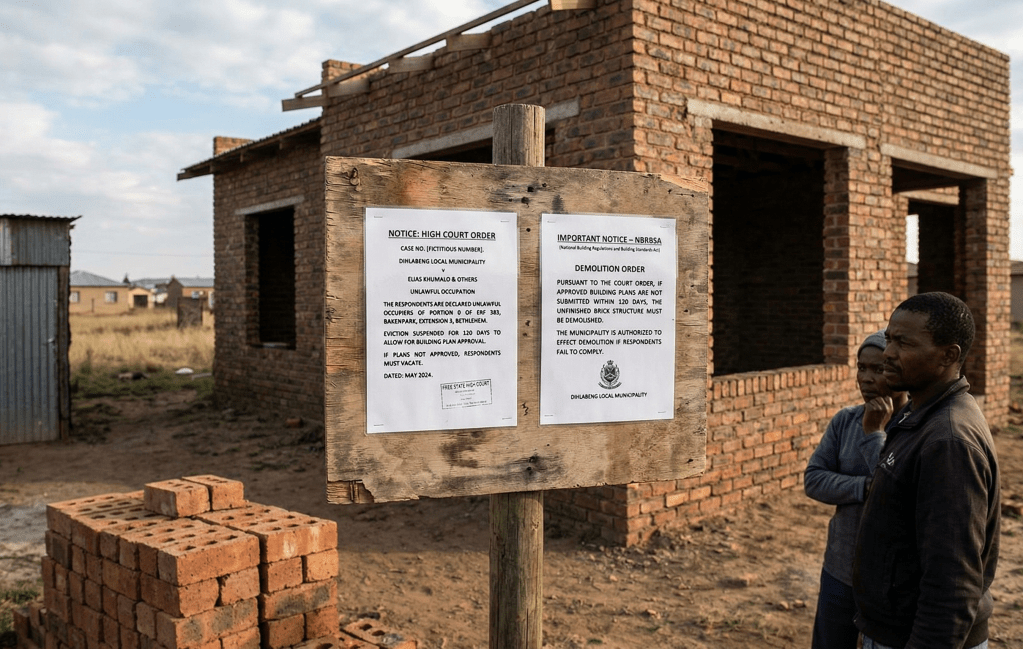
Dihlabeng Local Municipality v Khumalo and Another (2706/2024) [2024] ZAFSHC 257 (19 December 2024)
The applicant, Dihlabeng Local Municipality, sought an eviction order against the first respondent, Elias Khumalo, and the second respondent, comprising all unlawful occupiers of Portion 0 of Erf 383, Bakenpark, Extension 3, Bethlehem. The municipality alleged that the respondents were unlawfully occupying the property, which is registered in its name, and had erected structures without the necessary approval or building plans. The respondents opposed the application, claiming they had obtained permission from municipal officials to occupy and build on the property.
The property in question, Erf 383, Bakenpark, Extension 3, is registered in the name of Dihlabeng Local Municipality. The respondents occupied the property and erected a corrugated iron shack and a partially completed brick house. The municipality contended that these structures were built without approval or building plans, in contravention of the National Building Regulations and Building Standards Act (NBRBSA).1
The first respondent, Elias Khumalo, claimed to have paid R15,000 to a municipal councillor, Desmond Michaels, in 2017 for the right to occupy the property. He further alleged that another municipal official, Tshepo Mahlakwane, had authorised him to build a permanent structure. Khumalo submitted building plans and a valuation report, which the municipality disputed as fraudulent or incorrect.
In September 2023, the municipality issued a notice demanding that the respondents vacate the property and remove the structures. Despite this, the respondents continued to occupy and build on the property. The municipality initiated eviction proceedings only in May 2024, five months after becoming aware of the ongoing construction.
Legal Issues
- Whether the respondents were unlawful occupiers as defined in the Prevention of Illegal Eviction from and Unlawful Occupation of Land Act (PIE Act).2
- Whether it would be just and equitable to grant an eviction order, taking into account the respondents’ circumstances and the municipality’s delay in taking action.
- Whether the structures erected by the respondents should be demolished under the NBRBSA.
Analysis of Dihlabeng Local Municipality v Elias Khumalo
The court found that the respondents were unlawful occupiers under the PIE Act. The property is registered in the municipality’s name, and the respondents lacked express or tacit consent from the municipality to occupy or build on the property. The court rejected the respondents’ claim that they had received permission from municipal officials, as neither the late councillor Michaels nor the late Mr Mahlakwane had the authority to sell or allocate municipal land. The documents submitted by the respondents, including the building plans and verification report, were deemed unreliable and did not substantiate lawful occupation.
The court considered whether it would be just and equitable to evict the respondents, taking into account the following factors:
- The respondents had been in occupation of the property since at least 2020, when the first corrugated iron shack was erected.
- The municipality delayed taking action despite being aware of the occupation and construction since at least September 2023.
- The first respondent had invested R400,000 in constructing the brick house, and the property was occupied by his family, including minor children.
- The municipality did not provide evidence that the property was required for any specific purpose, such as public housing or other projects.
The court held that, in light of these factors, it would not be just and equitable to evict the respondents immediately. However, it imposed conditions to regularise the occupation.
The court found that the brick structure was erected in violation of the NBRBSA, as the respondents had not obtained approved building plans. The court ruled that, under section 21 of the NBRBSA it had no discretion but to order the demolition of the structure if the respondents failed to obtain approval for the building plans within 120 days.
Order
- The respondents were declared unlawful occupiers of Portion 0 of Erf 383, Bakenpark, Extension 3, Bethlehem.
- The respondents were ordered to vacate the property, but the eviction order was suspended for 120 days to allow the first respondent to obtain approval for the building plans.
- If the building plans were not approved within 120 days:
- The respondents were to vacate the property within 21 days.
- The first respondent was ordered to demolish and remove all structures within 60 days.
- The municipality was authorised to demolish the structures if the respondents failed to comply.
- No order as to costs was made, as the municipality was not substantially successful in its application, and the respondents’ actions contributed to the predicament.
Author’s Opinion
The court correctly applied the PIE Act, underscoring the need to balance the municipality’s property rights with the occupiers’ constitutional right to housing (section 26 of the Constitution). By suspending the eviction order, the court aligned with precedents such as Port Elizabeth Municipality v Various Occupiers,3 which emphasise that eviction must be “just and equitable.” However, the decision raises concerns about incentivising unlawful occupation. By granting respondents time to regularise their building plans, the court risks signalling that prolonged illegal occupation, coupled with financial investment, may shield occupiers from immediate eviction.
The municipality’s delayed action (five months between discovering the illegal construction and initiating proceedings) weakened its case. The court rightly criticised this inefficiency, as it allowed the respondents to make significant investments in the property. However, the judgment did not address potential systemic governance failures, such as corruption allegations involving councillors. The court’s reliance on Plascon-Evans to accept Khumalo’s version of events, despite disputed documentation, highlights the challenges of resolving factual disputes in motion proceedings, but may inadvertently condone reliance on informal (and potentially corrupt) arrangements.
The court’s application of Lester v Ndlambe Municipality4 and Aboobaker NO v Serengeti Rise5 was nuanced. While the NBRBSA mandates demolition for non-compliant structures, the 120-day grace period reflects judicial pragmatism. This approach balances strict legality with equity, permitting respondents to seek retroactive approval. However, it risks undermining the NBRBSA’s deterrent purpose if occupiers perceive a loophole to avoid demolition through belated compliance.
The court’s sensitivity to the respondents’ circumstances, particularly their R400,000 investment and family occupation, aligns with constitutional values of dignity and housing. This mirrors Occupiers of Erven 87 and 88 Berea v De Wet N.O.,6 where the Constitutional Court urged courts to consider occupiers’ personal circumstances. However, the judgment could strain municipal housing planning by encouraging ad hoc occupation, particularly in areas earmarked for public use.
You can read the full Dihlabeng Local Municipality v Elias Khumalo judgement here.
Written by Theo Tembo
Read more from The Legal Desk:






 The Legal Desk
Leave a comment