
Issue: Is it compulsory for learners to attend religious observances at school?
Question from Amira:
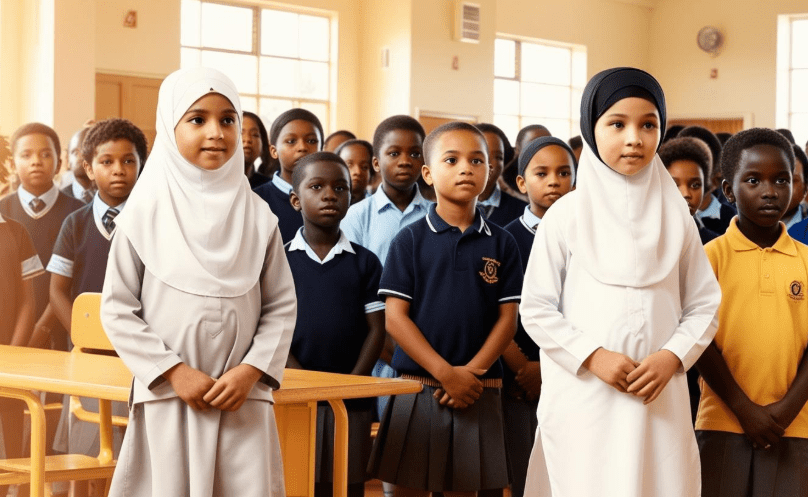
I had to relocate to a small town for work. I am Muslim, and so my children have always gone to a Muslim school. However, there isn’t one in my new town, probably because there just aren’t enough children for it. I did manage to get my children admitted to a school, though, albeit a non-Muslim one.
It’s not a “Christian School” per se, but the activities are primarily Christian or Christian-based. For example, the staff and learners say the Lord’s Prayer during assembly, and the headmaster begins his assembly message with a bible verse on which he bases his morning message.
I understand I cannot make them stop what they do and how they do it just to accommodate my two Muslim children. In fact, I do not want to stop them. It is their right to conduct their assemblies as they have always done. What I do want is for my children to be excused from these assemblies. I asked the headmaster if he could do so, but he refused, saying assemblies are compulsory for all learners. I asked for a compromise where my children could wait outside while the Christian hymns were sung, the Lord’s prayer was said, and the sermon was given. Again, he said this was impossible as the assembly’s attendance was compulsory.
Now that they aren’t getting a Muslim education, I worry about my children being overly exposed to another religion. It’s nothing against that religion or any other religion for that matter. It’s just a personal choice. Is there any way I can get the school to make an exception for my children?
From The Legal Desk
Thank you for your question, Amira. Religion is more than just beliefs or rules. It is a way of life that shows how a community thinks and behaves. Therefore, I understand your desire to maintain the authentic connection of your children with their religious practices. To better understand their rights, let’s take a look at the legals…
The relevant starting point is section 15(2)(c) of the Constitution of the Republic of South Africa, 1996 (“the Constitution”), which stipulates that religious observances can be conducted at State or State-aided institutions, provided attendance is both free and voluntary. This principle is reiterated in section 7 of the South African Schools Act (SASA),1 which notes that subject to the Constitution and any applicable provincial law, religious observances may be conducted at a public school under rules issued by the governing body if such observances are conducted on an equitable basis and attendance at them by learners and members of staff is free and voluntary.
Religious observance pertains to rituals or acts of a religious nature typically conducted in public settings, such as school assemblies, the opening of Parliament, or the commencement of a sports event. This is distinct from religious education, which involves learning about different religions’ beliefs and teachings within the classroom. Your message specifically concerns religious observances. It is crucial to note that compliance with the conditions outlined in section 15(2) is necessary only for the conduct of religious observances at State or State-aided institutions, not religious education.
To reiterate what I mentioned earlier, both section 15(2)(c) of the Constitution and section 7 of SASA explicitly state that attendance at any religious observances held at State or State-aided institutions must be voluntary and free. The Constitutional Court affirmed this principle in the case of S v Lawrence; S v Negal; S v Solberg,2 where it was unanimously agreed that the right to freedom of religion is safeguarded when there is an “absence of coercion or constraint” on a particular religious belief or practice. This stance was further restated in Prince v President of the Law Society of the Cape of Good Hope,3 where the court emphasised that implicit in the right to freedom of religion is the absence of coercion or restraint. Subsequent judgments by the Constitutional Court have consistently upheld this understanding of the scope of the right to freedom of religion.
Another significant outcome of the Lawrence judgement is its clarification that a State or State-aided institution is not obligated to facilitate religious observance in a manner accommodating every form of religion or non-religion within the institution. To illustrate using an example, if 85% of students in a school identify as Christian, 12% as Muslim, and the remaining 3% follow other religions or none at all, the school is likely required to accommodate Christian and Muslim observances in proportion to the respective adherents. However, there is no obligation to provide religious observance for the remaining 3% of students as long as everyone is free to choose whether to attend such events. The key is that the observance must be equitable, but it does not mandate absolute equal treatment of all religious beliefs.
Since your children are the sole Muslim students at the school, the institution is not obliged to arrange religious observance like Islamic prayers or readings from the Qur’an during assembly. However, your children and all other pupils must have the option to attend or abstain from events involving religious observance, such as the school assembly. It is essential to note that my discussion here assumes your children attend a public school. You did not specify whether they are in a public or independent (private) school. This distinction is important as the situation differs for independent schools.
State-aided institutions encompass entities, including educational ones, that are extensively funded and heavily regulated by the State. In the case of Wittmann v Deutscher Schulverein, Pretoria,4 the court did not classify independent schools as State-aided institutions under section 15(2), despite receiving some State funding. This interpretation is reasonable, as it would be inconsistent to allow institutions to establish their religion-based schools at their own expense under section 29(3) of the Constitution and simultaneously compel them to conduct religious observances equitably, freely, and voluntarily. Section 29(3) aims to empower religious organisations to establish parochial schools and promote their faith. Consequently, unlike public schools bound by section 15(2) of the Constitution, independent schools cannot be obligated to comply with the requirements of this section.
I trust you will be able to speak to the headmaster of your school to discuss section 15(2) if the school is a public school. Keep in mind, however, that excluding your children from assembly and other such events may leave them ostracised and on the receiving end of ire from the school’s administration.
You did not mention how old your children are. They may be old enough to ignore any potential ostracisation or young enough to be negatively affected by it. As such, it is crucial to determine if the few minutes they spend in a Christian-themed assembly will do as much damage as any potential ostracisation they may endure. All the best.
Written by Theo Tembo






 The Legal Desk
Leave a comment