
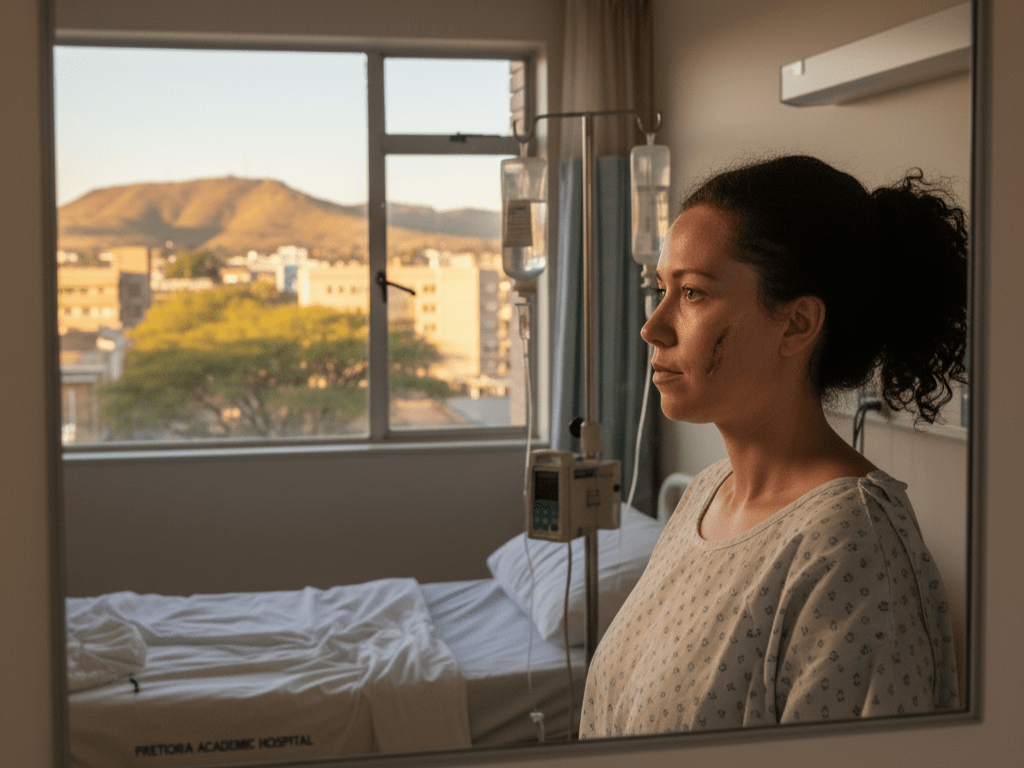
The Western Cape High Court has ruled in favour of a tourism consultant who sustained horrific facial injuries in a 2018 road accident. It ordered the Road Accident Fund (RAF) to pay R234,100 for laser treatment that successfully reduced her extensive scarring.
Jill Louise Allen was running with friends along the shoulder of Northshore Drive in Hout Bay on 25 February 2018 when she was struck by a vehicle driven by Ntokozo Shabala. The collision, caused solely by the driver’s negligence, left Allen with devastating injuries including facial bone fractures, a traumatic pneumothorax, multiple rib fractures, severe left eye injury, skull fracture, and extensive facial lacerations that left her permanently disfigured.
She spent 18 days in intensive care and underwent approximately 12 to 13 facial surgeries over several years. The initial emergency operation lasted 12 hours and included open reduction and internal fixation of all facial fractures, nasal reconstruction using costochondral graft, and extensive repair of lacerations and degloving injuries.
Dr Keith Cronwright, a plastic and reconstructive surgeon who testified as an expert witness, described Allen’s cranio-facial injuries as the worst such injuries he had seen in all his years of experience which date back to 1996.
While the RAF settled most aspects of Allen’s claim, including general damages and future medical expenses totalling R2.8 million, it refused to pay R239,450 for laser treatment Allen received from Libby Roos, a skincare therapist. The treatment, recommended by Allen’s plastic surgeon Dr Arnold Douglas, involved 50 sessions over 18 months using a Cutera laser genesis system. The RAF rejected the claim twice. First through bill reviewer Nizaamudien Abdul, then through its executive department which argued that Roos was not registered with the Health Professions Council of South Africa (HPCSA) and therefore did not qualify as a recognised healthcare provider.
The court heard compelling evidence about the treatment’s effectiveness. Both plaintiff and defendant experts agreed in a joint minute that the laser treatment yielded exceptional results with minimal residual scarification and improved both the appearance and functional effects of Allen’s scars. Dr Cronwright testified that the prominent scar running from Allen’s forehead down her nose to her chin was now virtually imperceptible, and described the transformation as “chalk and cheese” when comparing before-and-after photographs. He estimated the treatment’s success rate at 95%.
Significantly, the defendant’s own expert, Dr Kajal Lutchminarian, confirmed that surgical scar revision would have been contraindicated due to Allen’s use of anticoagulants for thrombosis. Thus laser treatment was the only viable option for scar management.
The RAF’s case rested primarily on section 4 of the Road Accident Fund Act (“RAF Act”), which they argued required service providers to be registered with relevant professional bodies. They cited the recent Fookwe v Road Accident Fund judgment, where payment to an unregistered acupuncturist was disallowed.
However, the court distinguished the current case and noted that, unlike acupuncture, there was no evidence that skincare therapists or cosmetologists were required to register with the HPCSA in 2018. Dr Cronwright’s unchallenged testimony confirmed that HPCSA registration was not required for laser treatment providers, and that such treatment was essentially a technician’s job rather than medical practice.
The court found that the RAF had failed to identify any specific legislative provision excluding payment for laser treatment. Section 19 of the RAF Act, which sets out exclusions from liability, contains no reference to unregistered service providers or laser treatment.
The court emphasised that the RAF Act should be interpreted broadly in favour of claimants, and cited the Constitutional Court’s ruling in Coughlan NO v Road Accident Fund that the RAF’s purpose is to give the greatest possible protection to claimants.
The court also noted that the laser treatment not only managed Allen’s physical scars but effectively erased them, and restored her dignity and self-confidence to return to work, which considerations aligned with constitutional protections of human dignity. Allen’s testimony revealed the profound psychological impact of her injuries. After seeing her scarred face for the first time in a hospital mirror, she feared she would have to hide for the rest of her life. The successful laser treatment enabled her to regain her self-confidence and return to her career in the tourism industry, where appearance and client interaction are crucial.
The judgment establishes important precedent for accident victims seeking compensation for effective treatments provided by qualified but unregistered practitioners, particularly where conventional medical alternatives are unavailable or contraindicated.
You can read the full Allen v Road Accident Fund judgement here.
Written by Theo Tembo
Read more from The Legal Desk:





 The Legal Desk
Leave a comment