
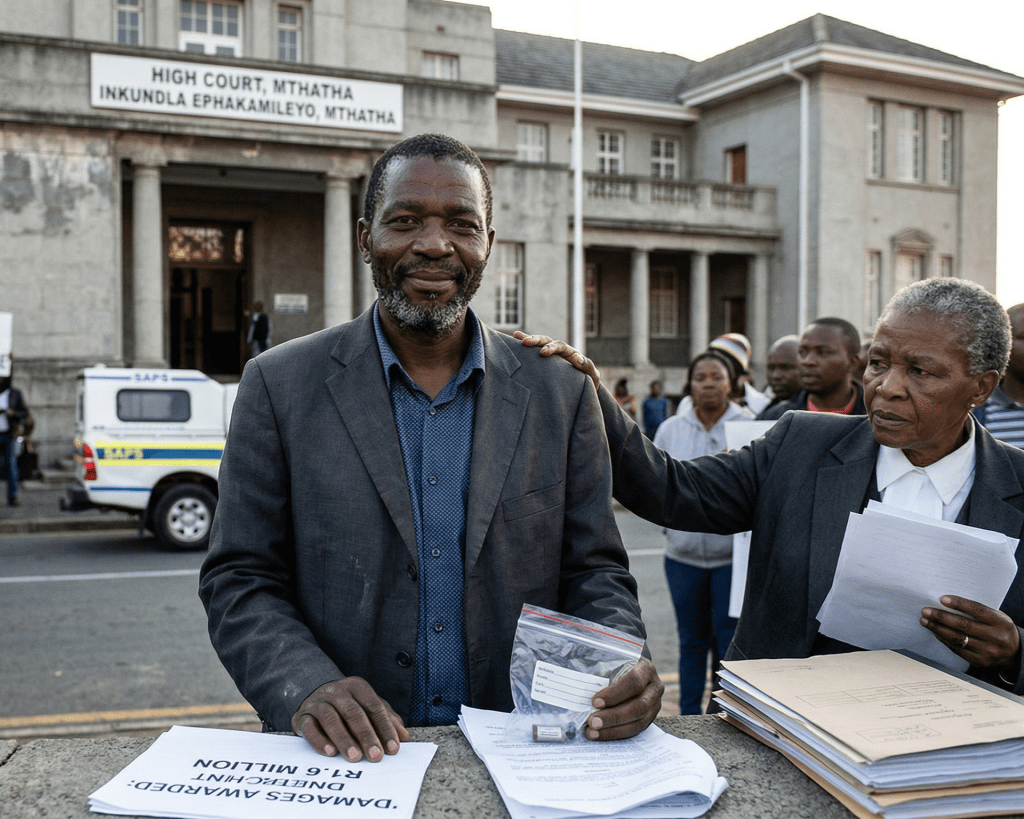
Minister of Police v Nontsele (547/2022) [2024] ZASCA 137 (11 October 2024)
Mr Mabhaso Nontsele (“Nontsele”) was arrested on 8 December 2013 and detained until 19 May 2015, a period of 527 days. He was arrested with two co-accused on charges of rape which allegedly took place at a traditional ceremony that took place two days before the arrest. At the trial, Nontsele was acquitted in terms of section 174 of the Criminal Procedure Act (the CPA),1 with the state conceding that there was no prima facie evidence against him.
Nontsele then sued the Minister of Police (the Minister) and the National Director of Public Prosecutions (the NDPP) for wrongful arrest, detention and malicious prosecution in the Eastern Cape Division of the High Court, Mthatha (“the High Court”). The court found that he had failed to prove both claims of unlawful arrest or malicious prosecution. However, it found his detention unlawful from the date of refusal of bail to the date of his release. It awarded damages in the amount of R1.6 million.2 The Minister applied for leave to appeal, which was refused by the High Court but granted by the Supreme Court of Appeals (SCA) on petition. The outcome of this appeal, 3-2 in the Minister’s favour, is the focus of this article.
The first judgement (Tolmay AJA, with Smith AJA concurring):
The first judgment treated Nontsele’s case as one of wrongful detention due to procedural failures by the South African Police Service (SAPS). The High Court initially awarded him R1.6 million for unlawful detention, finding that the police and prosecution failed to present all relevant evidence, such as the negative DNA results. This omission, the court argued, violated the duty of law enforcement to provide complete information during the bail hearing, as emphasised in Carmichele v Minister of Safety and Security (Centre for Applied Legal Studies Intervening)3 and Woji v Minister of Police.4 The court ruled that the prosecution’s failure to inform the magistrate of the state’s weak case directly contributed to the unjustified refusal of bail, thus rendering the entire period of Nontsele’s detention unlawful. It stressed the constitutional importance of personal freedom, as held in Mahlangu v Minister of Police.5 The appeal by the Minister was dismissed, and Nontsele’s cross-appeal was struck off due to procedural non-compliance.6
The second judgement (Dambuza JA, with Makgoka and Mabindla-Boqwana JJA concurring):
The second judgment emphasised the distinction between wrongful detention and malicious prosecution. Dambuza JA argued that Nontsele’s claim required proof of animus iniuriandi (intent to harm) and collusion between police and prosecutors, which are elements characteristic of malicious deprivation of liberty, not wrongful detention. The court found that circumstantial evidence, including witness statements and the complainant’s injuries, justified the opposition to bail despite the negative DNA results. Dambuza JA concluded that Nontsele failed to prove malicious intent or collusion, and thus, the claim for damages could not succeed. The High Court’s order awarding damages was overturned, and the Minister’s appeal was upheld.
Where the judgements diverged
The first point of divergence between the judgements was regarding the nature of the claim. Tolmay AJA viewed the matter as a wrongful detention case, emphasising procedural failures by the prosecution and police. She stressed the duty of law enforcement to disclose all relevant evidence, particularly the DNA results, to ensure a fair bail hearing. On the other hand, Dambuza JA categorised the claim as one of malicious prosecution, focusing rather on proving malice and improper conduct by state actors. She argued that the claim could not be sustained without evidence of collusion or animus iniuriandi. This interpretation placed a greater burden on Nontsele to prove intentional wrongdoing by the police and prosecution.
Then there was the analysis of evidence and causation, where Tolmay AJA held that the failure to disclose the DNA evidence significantly impacted the fairness of the bail proceedings, thus contributing to unlawful detention. Her judgment highlighted the duty of the police and prosecution to act transparently. Dambuza JA, on the other hand, downplayed the role of DNA evidence, emphasising, instead, that its absence did not automatically necessitate bail.7 She argued further that other circumstantial evidence provided a reasonable basis for the continued detention, suggesting that the DNA results were not decisive in determining bail eligibility.
As aforementioned, Tolmay AJA relied on principles of transparency and accountability, arguing that the state’s failure to disclose crucial information made the detention unjustified. She leaned on constitutional values of personal freedom as articulated in Mahlangu. Dambuza JA instead focused on the elements required for malicious prosecution claims, such as intent and malice, which were not proven. She distinguished the Nontsele case from cases like Woji and Zealand v Minister for Justice and Constitutional Development,8 which involved procedural errors leading to wrongful detention rather than allegations of malicious conduct.
Ultimately, Tolmay AJA upheld the High Court’s decision to award damages for unlawful detention, emphasising the failure of the police and prosecution to fulfil their legal duties during the bail hearing. Dambuza JA, on the other hand, overturned the High Court’s award, concluding that the evidence did not support a claim for malicious deprivation of liberty. She highlighted that procedural omissions did not equate to malice or intentional harm, thus rejecting Nontsele’s claim.
Author’s opinion
Dambuza JA’s rigid interpretation of malicious prosecution arguably neglected broader procedural failures by state actors. Her focus on proving collusion overshadowed the foundational duty of the state to act impartially and transparently during criminal proceedings. This emphasis on the formalistic label of the claim over its substance resulted in a missed opportunity to hold law enforcement accountable for negligence.
The author believes Dambuza JA’s high evidentiary threshold for proving malicious conduct shifts the burden of proof to the detained individual, thereby undermining the state’s duty to justify prolonged detention. This approach runs counter to the constitutional imperatives of accountability and the protection of personal freedoms, as outlined in section 12 of the Constitution of the Republic of South Africa, 1996 (the Constitution).
Furthermore, by downplaying the significance of the DNA results, the author submits that Dambuza JA failed to consider how timely disclosure might have influenced the bail outcome. While she was correct that DNA evidence alone does not dictate bail, the prosecution’s delay in revealing exculpatory information compromised the fairness of the process. This oversight reflects a departure from the principles established in Carmichele and Woji, which emphasise the duty of transparency in judicial proceedings.
The decision reflects a conservative judicial stance which appears to prioritise procedural formalism over the protection of vulnerable individuals who suffer from extended detention without adequate justification. The court’s reluctance to hold state actors accountable for negligence risks creating a precedent where procedural omissions are tolerated unless malice is explicitly proven.
The author posits that a more balanced approach would have involved considering the detention process’s overall fairness in conjunction with state actors’ responsibilities. The court could have applied a holistic test that examined the cumulative effect of procedural failures, including the delayed disclosure of DNA evidence, on the decision to deny bail. Such an analysis would align with constitutional principles and ensure that state actions meet a standard of integrity and fairness.
Ultimately, when all’s said and done, one cannot help but wonder what was more depressing for Nontsele; the 527 days of (“unlawful”) detention or the 1,156 days between the High Court awarding him R1,6 million in damages and the SCA snatching it away. Ouch!
You can read the full Minister of Police v Nontsele judgement here.
Written by Theo Tembo
Read more from The Legal Desk:
- 51 of 1977. ↩︎
- Nontsele v Minister of Police and Another [2021] ZAECMHC 29 par [56] and [76]. ↩︎
- [2001] ZACC 22; 2001 (4) SA 938 (CC); 2001 (10) BCLR 995 (CC). ↩︎
- 2015 (1) SACR 409 (SCA). ↩︎
- [2021] ZACC 10; 2021 (7) BCLR 698 (CC); 2021 (2) SACR 595 (CC) par [38]. ↩︎
- The cross-appeal was against the High Court’s findings that the respondent had proved neither unlawful arrest nor malicious prosecution. ↩︎
- This view is supported by Thwala v S [2018] ZACCC 34; 2019 (1) BCLR 156 (CC). ↩︎
- [2008] ZACC 3; 2008 (6) BCLR 601 (CC); 2008 (2) SACR 1 (CC); 2008 (4) SA 458 (CC). ↩︎





 The Legal Desk
Leave a comment