
Issue: Understanding the Legal Ownership of Roaming Animals
Here’s a question from Ntombomzi:
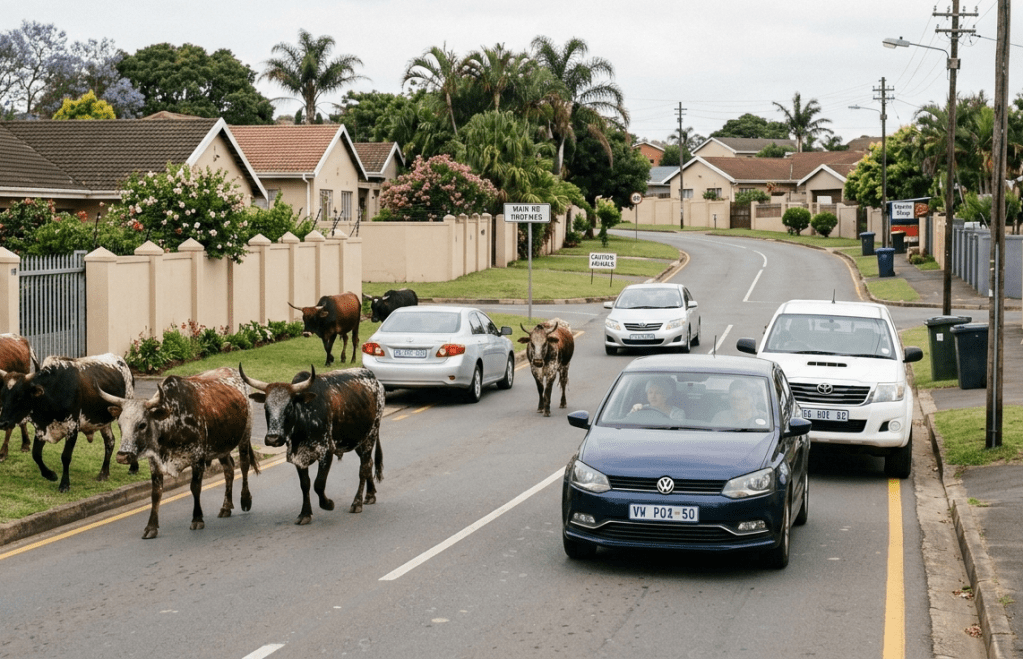
I live in the Eastern Cape. Even though I live in the city, I still regularly come across cows roaming the street. My daughter always jokes that we should take one home. We laugh about it, but I’ve actually wondered what’s stopping us. Aside from the obvious issue that it wouldn’t fit in my car, does it belong to anyone if it’s just roaming the streets?
From The Legal Desk
Thanks for your question, Ntombomzi.
I would be lying if I said I hadn’t also thought about helping a roaming cow or two find its way to my house. With the prices of meat and milk shooting through the roof, a cow would certainly come in handy. Unfortunately, as tempting as it is, and as annoying as stray animals can sometimes be, it’s not permitted to simply take them home. Let’s take a look at the legals…
The ownership of freely roaming animals is determined by their classification as either domesticated (res alicuius) or wild (res nullius), and is increasingly regulated by statutory measures that override traditional common law principles. For domesticated animals and pets, ownership does not cease simply because an animal is roaming. Instead, the law defines an owner broadly to include any person having possession, charge, custody, or control of that animal. Conversely, wild animals are legally considered unowned things (res nullius proper) until they are brought under human control through a process called appropriation (occupatio).
When domesticated animals such as cattle, horses, sheep, goats, dogs, or cats roam freely, they are generally classified as stray animals. This means they are not under the direct control of a person or have not been prevented from roaming. Ownership of these animals is retained by the original owner even if physical control is temporarily lost, as they are considered lost things (res deperditae) rather than abandoned ones. To assist in identification, the Animal Identification Act1 makes the permanent branding or marking of cattle, sheep, goats, and pigs compulsory. For pets, municipal by-laws may require cats to have collars or microchips containing the owner’s contact details.
In legal proceedings, there is often a presumption of ownership. An animal found on a particular premises or public place is presumed to be the property or under the control of the owner or occupier of that space unless the contrary is proven. However, the right to own roaming animals is balanced by the owner’s sole responsibility for their care and the prevention of public nuisances. Owners are legally prohibited from allowing their animals to be on any section of a public road or public place. If a roaming animal causes damage, such as a collision on a public road, the onus to prevent straying falls on the owner, who can be held liable for damages.
Under common law, wild animals (including birds and fish) belong to no one until they are captured or tamed. A person establishes ownership through appropriation, which requires sufficient and effective physical control combined with the intention to be the owner (animus domini). Historically, if a tamed wild animal escaped and regained its natural freedom without the intent to return, ownership was immediately lost, and the animal reverted to its res nullius status, thus making it available for appropriation by someone else.
This common law position has been significantly altered by the Game Theft Act.2 This Act stipulates that if wild animals are kept on land for commercial or hunting purposes under a valid certificate, ownership is not lost if they escape or are captured by an unauthorised person. In such cases, the animals remain the property of the landowner from whose land they escaped, effectively abolishing the common law rule that escaped game reverts to being unowned.
While private individuals may own roaming animals, the State and local municipalities have the authority to intervene when animals roam in a way that threatens public health or safety. Municipalities may seize and impound any apparently ownerless, stray, or dangerous animal found wandering unattended on public streets. Once an animal is impounded, the owner typically has a set window (varying by location and animal size, often 7 to 30 days) to claim the animal upon payment of seizure and accommodation costs.
If an owner fails to claim a roaming animal within the prescribed period, the City or municipality may forfeit the owner’s rights and choose to sell, donate, or destroy the animal. Furthermore, if an animal is found in a public place and is injured, diseased, or ferocious to the extent that it poses a danger to the public, an authorised official may order its immediate destruction or euthanasia.
In instances of criminal negligence where a roaming animal causes injury or death to a person, a court may not only order the animal’s removal or destruction but may also declare the owner unfit to own animals for a specified period. Thus, while the law respects private property rights in animals, those rights are conditional upon the owner’s ability to maintain effective control and prevent the animal from becoming a risk to the broader community.
Written by Theo Tembo
Read more from The Legal Desk:





 The Legal Desk
Leave a comment