
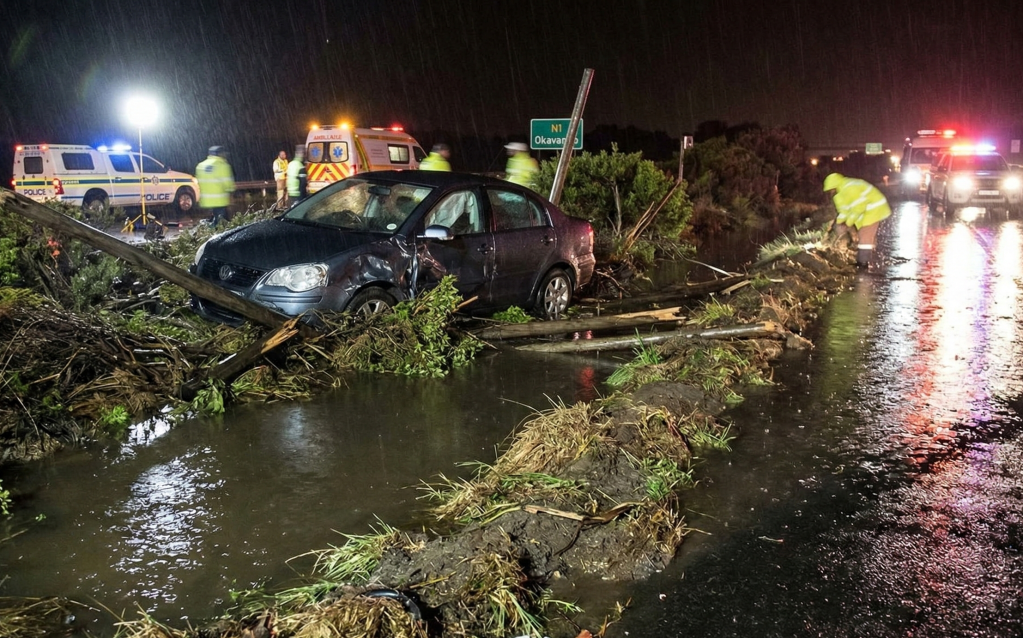
The Western Cape High Court has found the South African National Roads Agency (SANRAL) and two of its contractors jointly liable for injuries sustained by a motorist whose vehicle aquaplaned on a flooded section of the N1 freeway more than sixteen years ago.
Anton Hesse (“Hesse”) was travelling inbound on the N1 near the Okavango interchange at approximately 3am when his vehicle struck a substantial pool of water that had accumulated in the right-hand lane during heavy rain. The vehicle aquaplaned, rotated, and left the roadway, colliding with wooden poles and vegetation in the highway median. Hesse sustained physical injuries in the incident.
The court found that the flooding had been caused by a mundane and preventable maintenance problem. An accumulation of vegetation and soil along the median edge of the road, known in engineering parlance as “edge build-up,” that acted as a dam wall, obstructing the natural drainage of rainwater off the carriageway and causing it to pool at a known low point in the road.
SANRAL, which bears statutory responsibility for the planning, maintenance and operation of South Africa’s national roads under the National Roads Agency Act (SANRAL Act),1 had argued that it discharged its legal obligations by appointing two competent independent contractors, namely, Kayad Consulting Engineering and MD Civils to perform supervisory functions and to carry out routine road maintenance respectively. Under the principle established in the Supreme Court of Appeal (SCA) decision Chartaprops 16 (Pty) Ltd v Silberman,2 a principal who engages a competent independent contractor may, in appropriate circumstances, escape liability for the contractor’s negligence.
The court rejected this defence on the facts. Central to its reasoning was section 26(c) of the SANRAL Act. The court found that SANRAL’s oversight at the specific low point had been reactive rather than preventative because the maintenance regime only responded to the hazard after Hesse’s vehicle had already aquaplaned. Merely appointing competent contractors, the court held, was insufficient where SANRAL’s own statutory monitoring duty had not been reasonably discharged. The judgment aligned with Pick ‘n Pay Retailers v Williams,3 where the SCA reaffirmed that outsourcing does not absolve a principal where its systems of supervision are deficient.
The evidentiary record proved compelling. Emergency call-out records showed that water on the road had been reported at 3:15am and again at 12:35pm on the day of the collision. Three days later, the supervising engineer issued a formal instruction to MD Civils to remove edge build-up along the precise stretch of median adjacent to the low point, and some 200 metres of vegetation was subsequently cleared and certified for payment. The court described this sequence as objective corroboration that edge obstruction had been causally implicated in the hazard, and as evidence that the remedial step required was modest, practicable and long overdue.
An alternative theory advanced by the defendants, that the ponding had been caused by a leak from a municipal pipeline running through the median, was dismissed as speculative. No contemporaneous field notes, maintenance records or municipal documentation supported the hypothesis, and an inspection of the site conducted during the trial disclosed no indicators of any such historic failure.
The defendants’ plea that Hesse had been contributorily negligent, driving too fast or failing to maintain a proper lookout, was also rejected. The court noted that an independent witness had experienced a near-identical incident at the same location within hours of Hesse’s collision, suggesting the danger lay in the road’s condition rather than in any failing on the part of either driver.
You can read the full Hesse v SANRAL judgement here.
Written by Theo Tembo
Read more from The Legal Desk:





 The Legal Desk
Leave a comment