
S302(1)(a) Review: S v Mtshali (R41/2025) [2025] ZAKZPHC 16
Mr Nhlakanipho Mtshali (“Mtshali”), who was unrepresented, was charged with the theft of two tins of shoe polish, valued at R170, from a Spar store. He entered a plea of guilty in the Magistrate’s Court under section 112(1)(a) of the Criminal Procedure Act (CPA)1 and was subsequently convicted. The sentence imposed was a fine of R500 or six months imprisonment should he default on the payment of the fine. Furthermore, Mtshali was declared unfit to possess a firearm in terms of section 103(1) of the Firearms Control Act (FCA).2 The matter was brought before the High Court for review as the additional magistrate who presided over the case had held that position for less than seven years.
Section 302(1) of the CPA states:
“Any sentence imposed by a magistrate’s court – (i) which, in the case of imprisonment (including detention in a child and youth care centre providing a programme contemplated in section 191(2)(j) of the Children’s Act, 2005 (Act 32 of 2005)), exceeds a period of three months, if imposed by a judicial officer who has not held the substantive rank of magistrate or higher for a period of seven years, or which exceeds a period of six months, if imposed by a judicial officer who has held the substantive rank of magistrate or higher for a period of seven years or longer; …shall be subject in the ordinary course to review by a judge of the provincial or local division having jurisdiction”
The review court addressed the following legal issues:
- Whether the conviction of an unrepresented accused based solely on a plea under section 112(1)(a) of the CPA was appropriate.
- Whether the sentence of a R500 fine or six months’ imprisonment in default of payment was appropriate for the offence.
- Whether the declaration that the accused was unfit to possess a firearm in terms of section 103(1) of the FCA was lawful.
- Whether the conduct of the additional magistrate during the proceedings was acceptable.
As this was a review, formal arguments were not presented by the parties in the High Court. However, the reviewing judges raised concerns regarding several aspects of the proceedings and the sentence imposed by the magistrate.
Firstly, while Mtshali’s conviction was upheld (the court noted his voluntary admission to shoplifting and intention to plead guilty), the court cautioned that section 112(1)(a) of the CPA should be applied with circumspection when the accused is unrepresented. This is to ensure that only genuinely culpable individuals are convicted. Furthermore, the court set aside the original sentence and substituted it with a sentence of a fine of R500 or, in default of payment, imprisonment for a period of 30 days. The court reasoned that the original alternative sentence of six months’ imprisonment was disproportionately severe in comparison to the fine imposed, particularly given the application of section 112(1)(a).
Secondly, the issue of Mtshali’s fitness to possess a firearm was considered. The declaration that he was unfit to possess a firearm was also set aside. The court reasoned that theft is not an offence listed in section 103(1) of the FCA. While dishonesty is mentioned in section 103(1)(g), its application is contingent upon the imposition of a sentence of imprisonment without the option of a fine, which was not the case here as section 112(1)(a) necessitates a fine.
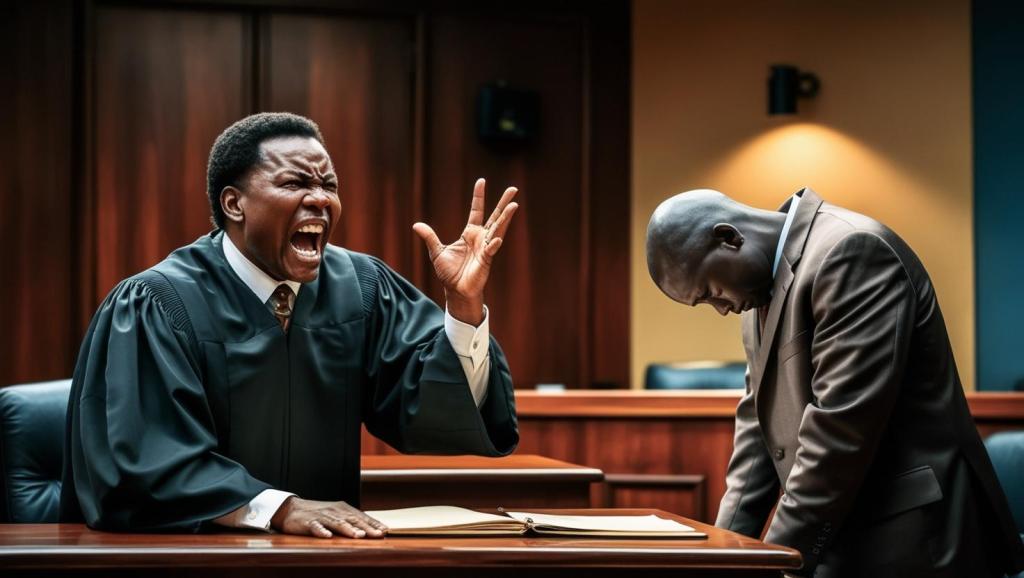
Finally, the court expressed profound disquiet regarding the “aggressive attitude” and “unacceptable manner” exhibited by the additional magistrate during the proceedings. The court highlighted instances where the magistrate addressed the accused in a disrespectful and insulting manner, including labelling him a liar and “the worst of the worst.”
The following is an excerpt of one of the exchanges highlighted by the review court:
COURT: Thank you. You can sit down. Yes, Mr Mntambo, would you – can you kindly address in aggravation?
PROSECUTOR: I had already addressed, Your Worship.
COURT: Oh yes, yes, you did. Thank you, sir. Stand up. Do you want to know how I knew that everything you were saying you were lying to me, because I am not a sangoma and I’m not a prophet?
ACCUSED: … [no audible reply]
COURT: It is your poor acting. You act like you are, you are shy when you are looking down and speaking softly. I can tell that you are the worst of the worst. The court will sentence you as follows.’
The court emphasised that judicial officers are expected to conduct themselves with courtesy and treat all individuals appearing before them with dignity, as enshrined in the Constitution of the Republic of South Africa, 1996 (“the Constitution”) and underscored in the case of Khuboni v S.3 The court condemned the magistrate’s conduct as “unjustified and intemperate” and likened it to “judicial bullying.” It asserted that such behaviour is unbecoming of a civilised legal system and must be discontinued.
Author’s Opinion
The reviewing court demonstrated a commendable commitment to ensuring fairness and justice in the application of the law, particularly for unrepresented accused persons. As is the role of a reviewing court, it correctly identified and rectified errors in the sentence imposed by the magistrate, thereby ensuring that the alternative imprisonment was proportionate to the fine.
However, what I would like to briefly discuss is the magistrate’s attitude in this matter. Unfortunately, it is something one sees all too often in courtrooms. In all my time spent in court, there are rarely more than a couple of days that pass without witnessing a magistrate berating, scolding, scoffing at, or otherwise displaying a negative attitude toward an accused person, particularly when the accused is unrepresented.
Every accused person possesses the right to choose, and be represented by, a legal practitioner, and to be informed of this right promptly.4 However, they also have the right to represent themselves. Such individuals are termed unrepresented accused. The Constitutional Court in S v Dlamini5 (citing various authorities including S v Lwane,6 S v Botha,7 Magmoed v Janse van Rensburg,8 and S v Nomzaza)9 reiterated the significant responsibility incumbent upon judicial officers to ensure the requisite understanding on the part of the unrepresented accused.
For example, in S v Buxeka,10 the court stated:
“A criminal trial is not a game where the magistrate plays the role of an umpire. He has to ensure the fairness of the whole proceedings. The need for judicial officers to assist unrepresented accused throughout the trial cannot be over-emphasised.”
Similarly, in S v Rall,11 the court held:
“If the accused is unrepresented, the judicial officer should and ordinarily would assist him or her to put his or her defence adequately, if necessary by the judicial officer him- or herself questioning prosecution witnesses as well as the accused and his or her witnesses.”
Ultimately, an unrepresented accused inevitably increases the magistrate’s workload to some extent. According to Erasmus,12 during a criminal trial, several procedural explanations must be thoroughly explained to an undefended accused person, including the right to legal representation,13 the explanation of plea,14 the right to cross-examination,15 the rights at the close of the prosecution’s case,16 the right to address the court on the merits of the case,17 and the right to address the court on sentence.18
Inevitably, unrepresented accused individuals may take more time during court proceedings. They often lack knowledge of courtroom etiquette, legal terminology, and procedural rules. This can result in misunderstandings, repetitive explanations, or procedural errors, all of which are behaviours which magistrates may interpret as disrespect or incompetence. For instance, in Mtshali, the magistrate rebuked the accused for not maintaining eye contact or speaking audibly. This reaction may well have been rooted in irritation at perceived non-compliance with formal norms.
Unrepresented individuals also tend to be unfamiliar with legal processes, struggle to articulate their defence, ask more questions, or require repeated explanations from the bench. This can understandably be a source of frustration for magistrates, who often manage overwhelming caseloads and tight schedules.
It is trite that magistrates and judges across the country are burdened with enormous caseloads. This relentless workload, often involving difficult and emotionally charged matters, can leave presiding officers in a constant state of emotional fatigue. Over time, such pressure can lead to stress and burnout, which may manifest as impatience, desensitisation, or even a lack of empathy, especially towards unrepresented accused individuals perceived as making proceedings more difficult.
Some magistrates may come to view these individuals not merely as underprepared, but as deliberately obstructive or disrespectful, particularly when they fail to grasp legal processes or the seriousness of the charges they face. This misperception can foster a judicial attitude of “we had to study and work hard to be here, and you think you can just walk in and do what we do,” resulting in frustration and, at times, overt hostility.
The reality is that unrepresented accused are inherently vulnerable. They lack legal advocacy to balance judicial authority, and this power imbalance can easily foster condescension or dismissiveness. Worse still, some magistrates may unconsciously conflate lack of representation with low socio-economic status, limited education, or diminished credibility.
And that’s what makes all of this so tragic. Those who typically bear the brunt of this treatment are the same individuals society routinely overlooks; the economically disadvantaged, the marginalised, the chronically underserved. Whether in courtrooms, hospitals, or retail stores, it is often these individuals who face the compounded consequences of institutional fatigue and individual frustration.
The magistrate’s remarks in Mtshali, such as calling the accused “the worst of the worst,” are not only derogatory but dehumanising. Rather than treating the accused as an individual entitled to dignity and due process, the magistrate reduced him to a stereotype. Even more concerning was the aggressive tone, including the dismissive statement, “I am not a sangoma… your poor acting.” Such language betrays a failure to empathetically engage with the accused’s nervousness or socio-economic context, such as the inability to afford legal representation.
As mentioned earlier, I have personally witnessed many cases in which presiding officers are harsh, curt, and sometimes downright boorish towards accused persons. I worry that the magistrate’s conduct in Mtshali, particularly the public shaming of the accused, reflects a broader and more entrenched culture, one that too often conflates judicial authority with intimidation, rather than fairness.
Yes, the review court in Mtshali rightly condemned the magistrate’s conduct. However, it stopped short of recommending any direct disciplinary action. It is not enough that it merely sent a copy of the judgment to the Registrar of the KwaZulu-Natal High Court and to the magistrate of the Newcastle Magistrate’s Court “for his consideration.” This response feels inadequate, given the seriousness of the misconduct.
There must be a firmer recommendation for accountability and consequences. If presiding officers are allowed to descend into the arena and joust with the accused, unchecked, the integrity of the justice system is undermined. Regardless of the stress, systemic failures, or workload pressures, judicial officers must never lose sight of the fact that they are dealing with people’s lives. Emotional outbursts and public humiliation should have no place in any courtroom. All accused must be treated with the same respect that the court demands from them. That is not just a matter of courtesy, it is central to the constitutional right to a fair trial.
You can read the S v Mtshali judgement here.
Written by Theo Tembo
Read more from The Legal Desk:
- 51 of 1977. ↩︎
- 60 of 2000. ↩︎
- [2021] ZAKZPHC 73; 2022 (1) SACR 470 (KZP) par [25]. ↩︎
- s35(3)(f) of the Constitution. ↩︎
- S v Dlamini, S v Dladla and Others; S v Joubert; S v Schietekat (CCT21/98, CCT22/98 , CCT2/99 , CCT4/99) [1999] ZACC 8; 1999 (4) SA 623. ↩︎
- 1966 (2) SA 433 (A). ↩︎
- 1995 (11) BCLR 1489 (W); 1995 (2) SACR 598 (W). ↩︎
- 1993 (1) SA 777 (A). ↩︎
- 1996 (2) SACR 14 (A). ↩︎
- [2021] ZAFSHC 255 (28 October 2021) par [15]. ↩︎
- 1982 (1) SA 828 (A) 831G). ↩︎
- Erasmus, D. “Procedural explanations and choices: The undefended accused in a minefield.” Law, Democracy & Development 13, no. 1 (2009): 13-39. ↩︎
- s73 of the CPA and ss35(3)(f) and (g) of the Constitution. ↩︎
- s115 of the CPA. ↩︎
- s166 of the CPA. ↩︎
- s151 of the CPA. ↩︎
- s175 of the CPA. ↩︎
- s274 of the CPA. ↩︎









Leave a comment