
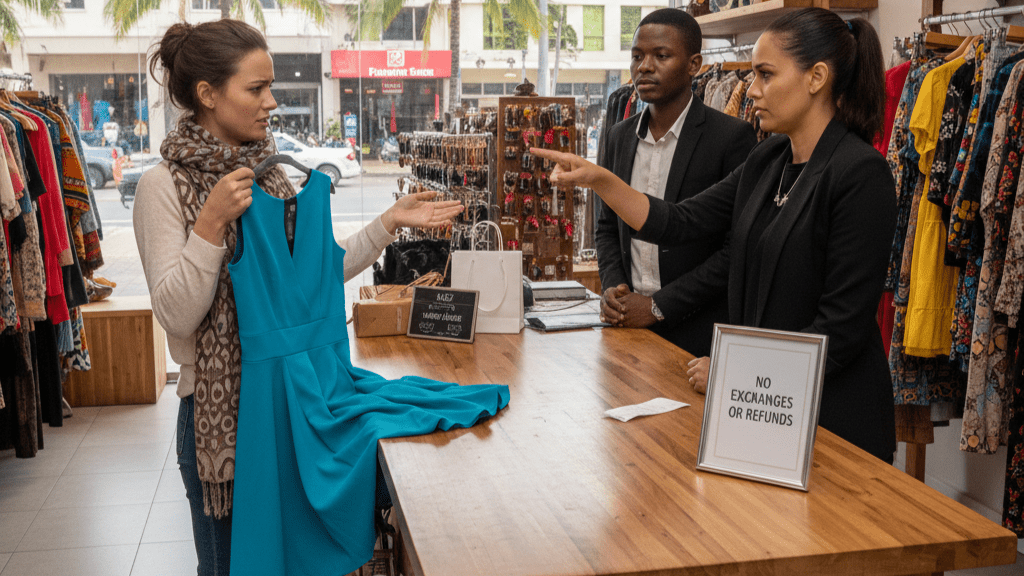
Issue: Is it legal for a retailer to refuse to accept the return of goods that you purchased from them if you no longer want those goods?
Here’s a question Stacey:
I bought some clothes from a popular boutique at a mall near where I live. A few days later, when I tried on one of the dresses again, I realised I just didn’t like how it looked on me. So I went back to return it, but the lady at the shop said they do not accept returns unless the clothes are damaged. I’m really annoyed. I have never had issues returning items at other stores before, even without giving a reason. Is it even legal for them to refuse my return?1
From The Legal Desk
Thanks for the question, Stacey. There is a common misconception regarding consumer law and the return of goods by a consumer to a retailer. Some stores will let you return goods for a refund with no questions asked; some will only offer an exchange rather than a refund; while others simply refuse to consider returns at all. So what’s the deal? Are retailers actually obliged to allow you to return goods? Let’s take a look at the legals…
In terms of the Consumer Protection Act (“CPA”),2 a consumer’s right to return a product applies only in specific circumstances and does not generally extend to situations where the consumer simply no longer wants the item. The following are the circumstances in which a consumer has a legal right to return goods:
1. Cooling-off Period after Direct Marketing
If a transaction resulted from direct marketing, a consumer may rescind the transaction without reason or penalty within five business days after the later of:
- The date the transaction or agreement was concluded.3
- The date the goods were delivered to the consumer.4
This right does not apply if section 44 of the Electronic Communications and Transactions Act5 already applies to the transaction.6 Upon rescission, the supplier must return any payment received within 15 business days, after either receiving notice of rescission (if no goods delivered) or receiving the goods back from the consumer.7
2. Goods Not Examined Before Delivery
If a consumer did not have an opportunity to examine the goods before delivery and rejected them for reasons contemplated in section 19(5) of the CPA, they may return them for a full refund.8 Section 19(5) states that upon delivery, the supplier must allow the consumer a reasonable opportunity to examine goods to ascertain if they are of the type and quality contemplated in the agreement, if they meet section s18(3) and (4) tests (i.e., description/sample), or if they conform to special order specifications.9
3. Mixed Goods
If a supplier delivers some goods mixed with goods of a different description not agreed upon, and the consumer has refused delivery of the non-conforming goods as contemplated in section 19(8), those goods can be returned for a full refund.10
4. Goods Unsuitable for a Particular Purpose
If a consumer specifically informed the supplier of a particular purpose for which they wished to acquire the goods (and the supplier ordinarily offers such goods or acts as if knowledgeable about their use), and the goods are found to be unsuitable for that purpose within 10 business days after delivery, the consumer has the right to return them for a full refund.11
5. Unsafe, Poor Quality, or Defective Goods
Every consumer has a right to receive goods that are reasonably suitable for their intended purposes, of good quality, in good working order, free of defects, and usable/durable for a reasonable period.12 If goods fail to satisfy these quality requirements and standards, the consumer may return them to the supplier within six months after delivery, without penalty and at the supplier’s risk and expense.13 The supplier must then, at the consumer’s direction, either repair or replace the goods, or refund the price paid.14 This right is in addition to any other implied or express warranties.15
What if you just do not want it anymore?
The five aforementioned reasons constitute the primary grounds for the return of goods. According to the CPA, the right to return a product does not generally extend to situations where a consumer simply no longer wants the product. Confusion often arises because many large retailers, at their discretion, allow consumers to return goods, even where no reason is provided. This practice reflects a business decision rather than a legal requirement. For example, a large retailer may decide that customer satisfaction holds greater importance, since satisfied customers often become repeat purchasers and recommend the business within their social circles. As a result, the benefit that may arise from a refusal to accept a return may be far less than the potential loss that follows when a customer feels dissatisfied after such a refusal.
In future, it is advisable to enquire about an outlet’s specific return policy before you make a purchase. That way you can be sure that your return expectations align with the retailer’s policy. All the best.
Written by Theo Tembo
Read more from The Legal Desk:
- The name of the retailer has been removed from the reader’s original email to The Legal Desk. ↩︎
- Act 68 of 2008. ↩︎
- s16(3)(a) of the CPA. ↩︎
- s16(3)(b) of the CPA. ↩︎
- Act 25 of 2002. ↩︎
- s16(1) of the CPA. ↩︎
- s16(4) of the CPA. ↩︎
- s20(2)(b) of the CPA. ↩︎
- s 19(5) of the CPA. ↩︎
- s20(2)(c); s19(8) of the CPA. ↩︎
- s20(2)(d); s55(3) of the CPA. ↩︎
- s55(2) of the CPA. ↩︎
- s56(2) of the CPA. ↩︎
- s56(2) of the CPA. ↩︎
- s56(4) of the CPA. ↩︎








Leave a Reply