
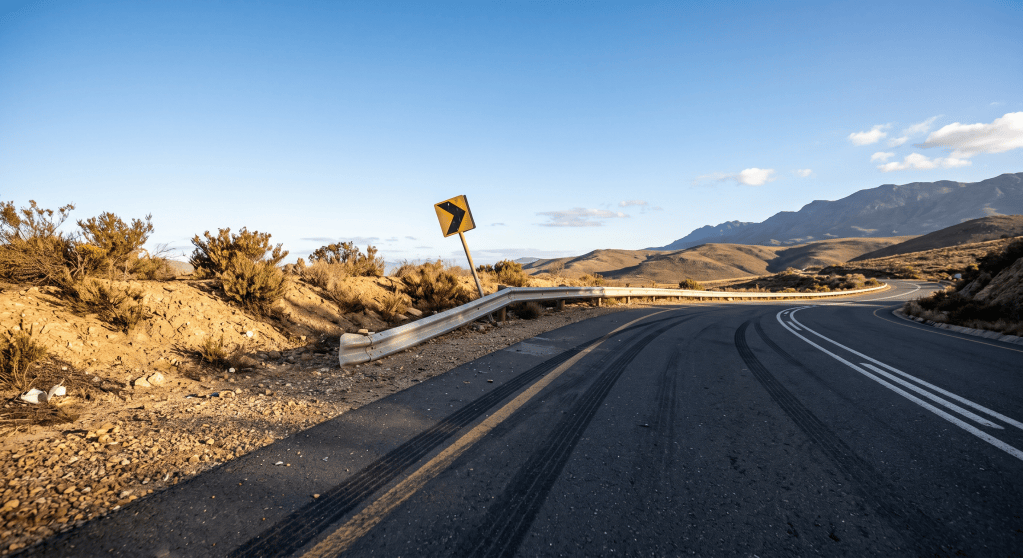
In a scathing judgment, the Western Cape High Court found the provincial government and its Department of Transport and Public Works fully liable for a tragic motorcycle accident that occurred nearly fifteen years ago. The accident took place on the afternoon of 29 October 2010. Andries Barend Kruger, an experienced rider, was travelling towards Worcester for a motorcycle rally alongside his wife, Elaine Jane Blanckenberg, who was riding as a pillion passenger. As they crested a blind rise on the Rooihoogte Pass, roughly 6.2 kilometres outside Villiersdorp, the road abruptly turned into a sharp rightward curve.
Kruger, unable to see the bend in time due to a severe lack of warning signs, failed to negotiate the turn. The motorcycle left the tarmac, plunging down an embankment and leaving both riders severely injured.
His friend, Hendrik Kok, who was following roughly nine meters behind, testified that Kruger “suddenly just disappeared” over the edge. Kok himself barely managed to stop on the gravel, narrowly avoiding the same fate.
The court separated the matters of liability and the quantum of damages, and focused the trial solely on who was to blame. The plaintiffs argued that the provincial authorities neglected their legal duty of care by failing to erect clear warning signs and maintaining an inappropriately high speed limit of 100km/h for such a hazardous bend.
During the trial, the court heard compelling testimony from Villiersdorp residents who painted a grim picture of the curve prior to 2011. Witnesses described it as an accident “black spot,” and recounted numerous crashes, some of them fatal. Local businessman Donovan Loesch testified that the curve was an absolutely dangerous corner, and noted that community members regularly warned passing motorists.
Isaac Malherbe, a local attorney, revealed he had sent urgent letters to the road authorities in November 2010, pleading for immediate intervention following a spate of serious accidents. Christopher Notley, a local farmer, corroborated this, and testified that he frequently assisted in the aftermath of fatal crashes in the area.
Central to the plaintiffs’ case was the absence of Chevron signs, the stark boards designed to guide drivers through sharp curves. Witnesses confirmed these signs were frequently knocked down and left unreplaced for considerable periods. At the time Kruger crashed, at most only one or two Chevrons remained standing, positioned so deep into the curve that they were invisible to approaching drivers until it was too late.
The defence attempted to deflect blame, and argued that Kruger was negligent and had failed to keep a proper lookout. They called upon transportation engineer Dr Herman Joubert, who controversially claimed that roadside vegetation and a dirt cutting should have provided enough visual guidance for Kruger to anticipate the bend.
The court dismissed this defence entirely, heavily criticising Dr Joubert’s evasive demeanour, internal contradictions, and lack of objectivity. He had even refused to contact the state’s own Roads Engineer to understand the signage upgrades, clearly stating he “had no intention to find out.” The court instead commended the plaintiffs’ expert, civil engineer Dr. Louis Roodt, who testified that road safety must rely on proper engineering measures, not shrubbery.
Perhaps the most damning evidence was the state’s subsequent conduct. After the crash, the Department of Transport significantly upgraded the signage. They installed a high-visibility winding road sign, a “gentle curve” warning, lowered the advisory speed limit to 80km/h, and erected a full array of Chevron signs that are now promptly replaced. Tellingly, the defendants failed to call their own Roads Engineer to explain why these critical safety measures were absent when Kruger crashed.
Elaine Blanckenberg testified that for four months following the crash, she travelled past the site weekly for hospital visits, observing only a single Chevron standing. She personally approached local authorities, warning them that a 100km/h speed limit around that bend was a recipe for disaster.
The court ruled that the provincial government acted wrongfully and negligently by failing to warn the public of the hidden hazard. It found no contributory negligence on Kruger’s part, and declared that any reasonable motorcyclist would have been caught off guard by the invisible curve.
An attempt by the defendants to drag the Road Accident Fund (RAF) into the case to offset their liability was also dismissed. The court ruled the state’s counter-application was legally flawed under the amended RAF Act, and ordered them to pay the RAF’s costs.
Written by Theo Tembo
Read more from The Legal Desk:





 The Legal Desk
Leave a comment